
Donating: how, where and can I?
Giving blood, plasma or platelets. We do that for each other. For whoever needs it. One day that might be your neighbor, your teammate or your mother. Help out too! Whether you qualify to become a blood donor? How it works? Where can you do it? You can read all about it here.
Where to give?
What is the closest option for me?
When making an appointment, you can search by location. Enter your location in our donor portal and you will immediately get an overview of the nearest options. Also tick whether you want to donate blood, plasma or platelets. The donor portal includes both the permanent collection sites (our donor centers in the cities) and the mobile collections that are held throughout Flanders. So you can quickly and easily find what suits you best.
You can give blood anywhere, plasma in all our donor centers and platelets only in the Bruges, Edegem, Genk, Ghent, Leuven and Mechelen donor centers.
Can we host a blood collection at a location of your choice?
Yes, you can organize an on-site blood collection as a company, business park or organization if you have at least 750 employees or sympathizers. We provide you with all the necessary material to get everyone excited: flyers, banners, videos, standard emails, posters and an online registration module. Contact us at relatiebeheer@rodekruis.be for more info.
Fewer than 750 colleagues or members? Then trek with your company to Belgian Red Cross-Flanders. Plan a team outing to the nearest donor center. A looser atmosphere for consultation, informal discussions and doing a good deed as a team: only benefits!
Giving what?
What is the difference between blood, plasma and platelets?
Donating blood, plasma, or platelets saves lives. Read all about the different blood products here. You can also make an invaluable contribution by registering as a stem cell donor.
Is my blood type needed?
Yes, because every blood type is truly needed. As you may know, you can’t just give blood to anyone or receive blood from anyone. It depends on your blood type and Rh factor. So your blood type determines who can receive your blood. But one thing is certain: your blood type helps people and saves lives no matter what! Your blood type is also important when it comes to plasma. See here who you’re helping and what the supply of your blood type looks like.
Why do we work with donating by appointment?
Why do I need to make an appointment to donate?
Waiting your turn to give blood or plasma because it's just a busy time? Having to stand in line to save lives? Tell me, you'd rather not. And we also like to make it as easy and accessible as possible for our donors. That's why we work with an appointment system.
So, are you planning to donate? If so, we ask that you always make an appointment in advance. You can even do this on the day of your visit. That way, we can welcome you right away. You can make an appointment online via the donor portal or by calling the toll-free number 0800 777 00.
How do we communicate with (potential) donors?
Are you calling people to come and donate?
Yes. As part of the blood supply, call agents for the Red Cross call (potential) donors. They ask to come and donate again. We work with an external partner who has experience with charities for this purpose. The call agents receive specific training from Belgian Red Cross-Flanders so they can provide the right information. We call from the number +32 2 880 11 81.
Have you been called and have questions about this? Please let us know at bloed@rodekruis.be or call us on 015 44 39 99.
Do you have a newsletter that I can subscribe to?
Sure! If you want to stay up to date with all the news and promotions, send an email to bloed@rodekruis.be so we can send you monthly updates.
What for my donation?
What can I eat or drink before giving blood, plasma or platelets?
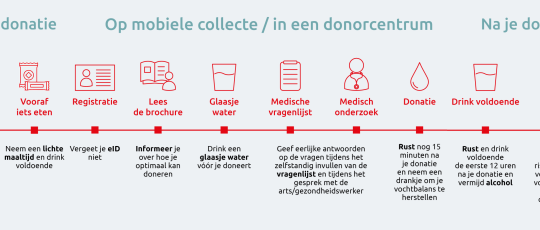
Don't come to your donation hungry. Also avoid the opposite: a heavy, greasy meal just before with lots of cheese, fries, mayonnaise, eggs, bacon, butter or whipped cream, for example. Then you are more likely to feeling unwell during or after your donation. Eating a normal, easily digestible meal about 2 hours beforehand is ideal. A rest, cookie and otherwise normal diet is also sufficient to restore blood components quickly afterwards.
Drink more water than usual both before and after your donation to maintain proper hydration. Of course, other non-alcoholic beverages are also fine. At our blood drives and donor centers, you’ll be offered water and other drinks before and after your donation. Be sure to accept them. In the 24 hours following your donation, it’s a good idea to avoid diuretic beverages such as alcohol and coffee.
Also avoid alcohol in the 24 hours before donation. Or compensate for alcohol consumption by drinking plenty of water. Those who arrive drunk will be turned away.
What after my donation?
Can I exercise or work immediately after my donation?
What about eating or drinking alcohol after my donation?
Still have doubts, a question or want to pass on a complaint after your donation?
Will I get a thank you?
Yes, you'll receive a small token of our appreciation. Check out your benefits here.
How often and how much should I give?
How much time should you leave between donations?
Depending on what you give, there will have to be a different time between your donations.
Blood
- You may donate blood up to 4 times a year. After each donation, you must wait at least 2 months before donating again. (Only under strict conditions may someone with hemochromatosis donate blood up to 6 times a year.)
Plasma
- You may donate every 2 weeks.
Platelets
- You may donate every 2 weeks and up to 24 times per year.
Combination
If you combine blood, plasma, and/or platelets, you may make a maximum of 26 donations per year intotal.
- After donating blood, you must wait at least 4 weeks before you can donate plasma or platelets again.
- After donating blood, you must wait at least two months before you can donate again.
- After donating plasma or platelets, you must also wait two weeks before donating blood again.
What amount of blood will be drawn from me?
The attending physician will determine how much blood, plasma or platelets you can donate based on the medical questionnaire and medical examination before the collection. If you are healthy, you may well lack some blood, plasma or platelets. After all, your body makes them all the time.
- On average, a healthy adult's body contains 4 to 6 liters of blood, depending on your weight. A rule of thumb is that a person has about 1/13th of their body weight in blood. Men generally have more blood in their bodies than women. A donation may take 450 or 470 ml of blood (depending on your height, weight and gender).
- For plasma, the maximum amount is 765 ml.
- For platelets, the maximum amount is 500 ml.
How do you guarantee security and privacy?
How do you provide security?
- Safety is our top priority. We want to ensure that the donation process is safe for you as a donor—and for the patient who receives your blood. That is why, in certain cases, you may not be eligible to donate blood, plasma, or platelets—either temporarily or permanently. We conduct a donor screening process before the donation. We ask you questions and perform a brief examination. Ourselection criteria are scientifically based.
- We use only specially trained personnel to draw blood, plasma and platelets. Blood sampling (by venous or capillary puncture) is a nursing act B2 defined in the R.D. of June 18, 1990 as "Blood Collection". That R.D. also stipulates that the nurse may independently draw blood from the donor, provided that the physician has given permission. In the past, other professional categories (medical laboratory technologists, pharmacists) were issued the special certificate 'Blood collection by venous punctures'.
- Sterile material is used that is for your use only. After use, it is discarded.
- Your diet is more than sufficient to quickly restore the blood components given off. Female donors under 50 years of age are asked by the doctor to take an iron supplement for several days after blood donation.
- Good communication is also essential for safety. That is why you must speak Dutch, French, English, or German to donate blood. Before donating, every donor must meet with the collection physician. The physician will conduct a brief medical examination, review your answers to the medical questionnaire, and ask additional questions. You can also ask the physician any questions you may have about your donation. We therefore ask that you speak Dutch, French, English, or German to make this possible. After all, it is important that our collection physician can ask questions and understand you. Conversely, you must be able to understand and answer his questions. Only then can we guarantee that the collected blood is safe. We do our utmost to speak French, English, and German fluently in addition to Dutch, so that we can accommodate as many donors as possible. A translation of the medical questionnaire into French, English, and German is available at every donor center.
Is it important that donation be voluntary?
Yes, for the safety of blood products, it is very important that donation is based on voluntariness. People who voluntarily donate blood do it for each other. Out of conviction. Because they want to help people around them.
May I withdraw as a donor?
Yes, at any time you can withdraw as a donor. Even if you are in the takedown seat, you can decide not to go through with it. You can also decide at any time that you no longer want to be a donor. Donating blood, plasma or platelets once does not imply any obligations for the future.
Why do I have to show my ID card?
When you register, we use your electronic identity card for unambiguous and unquestionable identification of you as a donor. This is fundamental to be able to follow the path of your donation to the recipient at any time.
Through the chip we read the following data: the national register number, name, first name, date of birth, sex, address and photograph.
We are authorized by the National Register Sector Committee to use the National Register identification number.
What happens to my personal information?
We only use your personal data for the management of our administrative and medical data, and anonymous information about our blood transfusion activities. According to the legislation on privacy protection, you have the right to access and modify your personal data upon written request.
What does "informed consent" mean?
This means that you gave informed consent for the collection of your blood, plasma or platelets. Knowledgeable means that you read the educational materials, had the opportunity to ask questions and received satisfactory answers. It also means that you gave information in the medical questionnaire and during the medical examination that was truthful to the best of your knowledge.
Consent is also requested for the use of residual samples for scientific and epidemiological research. If you do not wish this, you may opt-out on the medical questionnaire.
Finally, you indicate that you have been informed that you must not perform any dangerous occupations, or physical or sporting activities with risk to yourself or others for 12 hours after the blood collection. If you have any questions about your donation, you can always discuss this with the collection doctor.